AI in Pharmacovigilance: Automating Adverse Event Processing and Safety Signal Detection
Discover how AI in pharmacovigilance automates adverse event processing, improves drug safety analytics, and supports faster pharmacovigilance signal detection.
Blog
AI in Pharmacovigilance: Automating Adverse Event Processing and Safety Signal Detection
AI in Pharmacovigilance: Adverse Event Processing
Discover how AI in pharmacovigilance automates adverse event processing, improves drug safety analytics, and supports faster pharmacovigilance signal detection.
AI in Pharmacovigilance: Automating Adverse Event Processing and Safety Signal Detection
Published: Nov 19th, 2026
Pharmacovigilance has a volume problem. The FDA’s Adverse Event Reporting System (FAERS) logged more than two million reports in 2023, nearly triple the level of 2011, and that is one regulator among many. Reports also arrive from clinical trials, patient support programmes, medical literature, social media, and health records, in every format from structured forms to faxed letters and call transcripts. Each one has to be received, validated, coded, assessed, and where required reported within fixed regulatory timelines, and much of that work is still done by hand. The result is a workload that grows faster than headcount.
AI in pharmacovigilance promises to take on the repetitive parts of that workload and to find patterns in safety data that no reviewer could spot unaided. It is also a field where mistakes carry unusual weight, because a missed signal can mean patient harm. That tension explains why regulators and industry have moved from enthusiasm to guidance: CIOMS published its first consensus report on AI in pharmacovigilance in December 2025, and the FDA and EMA issued joint principles for AI across the medicines lifecycle in January 2026, naming machine-learning-driven signal detection among the intended applications. Success depends as much on governance and data foundations as on the models themselves.
This article looks at how automation is changing adverse event processing, how AI supports signal detection, where the evidence is still maturing, and what safety teams need in place before deploying it. It is written for safety, regulatory, and data leaders deciding where to start.
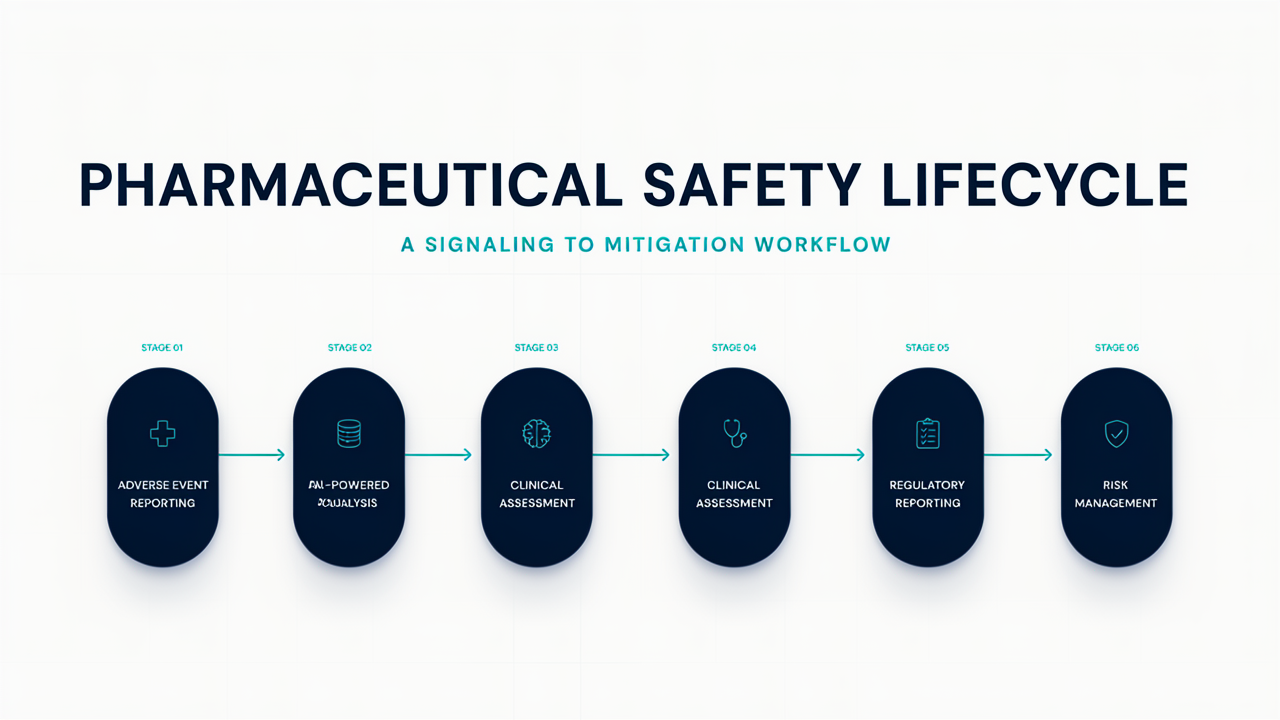
How AI in pharmacovigilance works across the safety lifecycle
Pharmacovigilance covers the collection, detection, assessment, and prevention of adverse effects across a product’s life. AI does not replace that lifecycle. It changes who or what does the first pass at each stage, and where human attention is spent.
Stage
What happens
Where AI helps
Human role
Intake and triage
Reports are received from many sources and checked for minimum valid-case criteria.
Reads unstructured text, classifies report type, and flags seriousness.
Confirms validity and priority.
Data extraction and coding
Patient, product, reporter, and event details are captured and coded to MedDRA and drug dictionaries.
Extracts fields and suggests codes with confidence scores.
Reviews low-confidence and serious cases.
Duplicate detection and follow-up
Related reports are matched and missing details are requested.
Scores likely duplicates and drafts follow-up queries.
Decides on merging and follow-up.
Assessment and narrative
Seriousness, expectedness, and causality are assessed and a narrative is written.
Drafts narratives and highlights relevant history.
Owns the medical judgement.
Reporting and submission
Cases are submitted to regulators within deadlines.
Checks completeness, routes cases, and tracks clocks.
Approves submissions.
Signal detection
Aggregated data is screened for new or changing risks.
Ranks associations and mines text and real-world data.
Validates and evaluates signals.
Risk management
Findings feed benefit-risk assessment and label changes.
Summarises evidence and supports aggregate reports.
Makes the decision.
Adverse event processing automation in practice
Case processing is where most safety teams start, because the work is high-volume, repetitive, and measurable.
Intake and triage
Safety teams receive reports by email, fax, phone, web forms, partner feeds, and literature alerts. Adverse event processing automation starts by reading these sources and extracting the four elements that make a report valid: an identifiable patient, an identifiable reporter, a suspect product, and an adverse event. It then classifies the case by seriousness so that expedited reports, whose clocks can be as short as 7 to 15 calendar days, are prioritised. Large language models have widened what can be read: free-text narratives, call transcripts, and scanned documents that once needed manual transcription are now candidates for automated intake.
Extraction, coding, and duplicate detection
Once a case is open, natural language processing can extract medical terms and map them to MedDRA, identify products and doses, and propose a coding with a confidence score. Duplicate detection compares new reports with existing cases on patient, product, event, and timing attributes. The practical design question is where to set confidence thresholds. High-confidence, low-risk fields can be pre-filled for quick verification, while low-confidence or serious cases are routed to an experienced reviewer.
Narratives, assessment, and follow-up
Generative models can draft case narratives, summarise relevant medical history, and suggest follow-up questions where key details are missing. These are assistive uses. Seriousness, expectedness, and causality are medical judgements, and the human reviewer remains accountable for them. Generative output also needs checking for statements the source report does not support, a known failure mode of language models.
Choosing the right level of human oversight
The CIOMS work describes three oversight models: human in the loop, where a person reviews every output; human on the loop, where a person monitors and samples performance; and human in command, where people set the boundaries within which the system operates. The right choice depends on the risk of the task. A suggested code on a non-serious case and a seriousness classification on a potentially fatal outcome warrant different levels of review.
Drug safety analytics beyond individual cases
Drug safety analytics extends the view from single cases to patterns across products, populations, and sources. Surging report volumes and the growing share of unstructured data make it hard for manual processes to detect signals buried in free text, which is where analytics earns its place.
Combining sources. Spontaneous reports, clinical trial data, literature, registries, and real-world data such as claims and health records each show part of the safety profile. Analysed together, they show more than any one source can.
Adding context. Spontaneous reporting systems do not record how many patients take a drug, so a count of reports cannot say how common an event is. Real-world data can supply exposure and background event rates, which turns a raw count into something closer to a risk.
Making it usable. Safety physicians need dashboards that rank what matters, drill down to the underlying cases, and show why something was flagged, not a longer list of alerts.
Closing the loop. Findings only matter if they reach risk management plans, labelling, and communication with regulators and clinicians, and that requires the analytics to sit close to the safety database rather than beside it.
Pharmacovigilance signal detection: what AI changes
Signal detection is the search for new or changing risks in safety data. In spontaneous reporting systems, which lack data on the total number of patients using a drug, the workhorse has been disproportionality analysis: comparing how often an event is reported with one product against how often it is reported with others, using measures such as the proportional reporting ratio, the reporting odds ratio, and Bayesian methods. These methods are transparent and well understood, but they are sensitive to under-reporting, reporting bias, and noise, and every statistical flag still needs clinical review before it becomes a validated signal.
Approach
Strengths
Limitations
Disproportionality (PRR, ROR)
Simple, transparent, widely accepted.
No exposure data, sensitive to reporting bias, many false alerts.
Combine many features, may detect earlier and rarer signals.
Need reliable reference data, less transparent, require validation.
NLP and real-world data approaches
Draw on free text, health records, claims, and literature.
Data quality, linkage, privacy, and confounding.
The evidence for machine learning is encouraging. A systematic review of machine learning in pharmacovigilance signal detection found that algorithms such as random forest, gradient boosting, and k-means generally outperformed traditional frequentist and Bayesian disproportionality measures on several metrics. A 2026 systematic review presented at ISPOR reached a similar conclusion, citing advantages in sensitivity, early detection, and rare event identification.
A better statistic is not automatically a better decision. More sensitive methods raise more alerts, and unless the workflow can triage them, the result is a bigger backlog rather than faster protection. The most useful AI support in signal management is therefore prioritisation: ranking candidates by clinical relevance, strength of evidence, and novelty, and showing the reviewer why. It is also worth remembering that an association in data is a hypothesis. AI can surface it faster, but clinical evaluation is still what turns it into a signal.
Where the evidence is still maturing
The case for AI in pharmacovigilance is strong in logic, and the published evidence is more mixed than vendor material suggests. Reported results such as large cuts in case turnaround, processing backlogs, or cost per case typically come from vendors or sponsor case studies without baselines, comparators, or methods. They show what is possible rather than what a typical team should expect.
Academic reviews that favour machine learning for signal detection are encouraging, but they are largely retrospective analyses of public spontaneous report datasets, where the reference sets used to define a true signal are themselves imperfect. A meta-epidemiological study also found poor transparency and reporting in disproportionality analyses, which makes comparison harder still.
Several practical constraints recur:
Uneven data quality. Under-reporting, missing fields, and inconsistent coding limit what any model can learn.
Language-model errors. Generated narratives and summaries can include unsupported statements, so verification steps are essential.
Drift. Products, populations, and coding practices change, and a model validated last year may not behave the same way this year.
Bias. Groups that are under-reported or under-represented in training data may be under-served by the model.
Integration. Outputs have to flow into a validated safety database and an auditable workflow, not sit in a separate tool.
Governance and regulatory expectations for AI in pharmacovigilance
Regulatory expectations are converging on a common message: use AI, but be able to show that it is fit for purpose, overseen by people, and under control throughout its life.
CIOMS Working Group XIV. The Council for International Organizations of Medical Sciences published its Artificial Intelligence in Pharmacovigilance report on 4 December 2025, following a 2025 public consultation that drew more than 1,000 comments from 46 organisations. It sets out principles including a risk-based approach, human oversight, validity and robustness, transparency, data privacy, fairness, and governance, and applies them to pharmacovigilance use cases such as case processing and signal detection.
FDA and EMA joint principles. In January 2026 the FDA and EMA published ten guiding principles of good AI practice across the medicines lifecycle. They cover human-centric design, a risk-based approach, adherence to standards such as GxP, a clear context of use, multidisciplinary expertise, data governance and documentation, sound model design, risk-based performance assessment, lifecycle management, and clear plain-language information. Adoption is currently voluntary, but machine-learning-driven pharmacovigilance and signal detection are named among the uses to which they could apply.
FDA draft guidance. The FDA’s January 2025 draft guidance on AI to support regulatory decision-making [FDA-2024-D-4689] sets out a risk-based credibility assessment built around a defined context of use. It applies where an AI model produces information intended to support a regulatory decision on safety, effectiveness, or quality, so teams should check whether a given pharmacovigilance use falls within it.
EU AI Act. Whether an AI system in pharmacovigilance counts as high-risk under the EU AI Act depends on its specific use and may need case-by-case assessment. The CIOMS work translates the Act’s high-level requirements on risk management, transparency, human oversight, and data protection into pharmacovigilance practice.
Privacy and data protection. Safety reports routinely contain identifiable health information about patients and reporters, so data protection laws such as the GDPR and HIPAA apply to both the data and the models trained on it, including cross-border transfers.
Validation and accountability. Systems that support GxP-regulated activities need computerised system validation, audit trails under 21 CFR Part 11, and change control, and a model that keeps updating itself raises questions a locked system does not. Whatever tools are used, responsibility for safety reporting stays with the marketing authorisation holder, so oversight, documentation, and inspection readiness cannot be delegated to the tool.
A practical roadmap
Start with high-volume, lower-risk tasks. Intake classification, duplicate detection, and coding suggestions with full human review give early value with contained risk.
Define the context of use and risk level. For each use case, state what the AI decides, what a person decides, and what harm an error could cause.
Establish reference standards and validate on your own data. Measure performance field by field and by case type, with particular attention to serious cases, rather than relying on a single overall accuracy figure.
Design human oversight deliberately. Choose in-the-loop, on-the-loop, or in-command oversight for each task, and train reviewers to challenge outputs rather than accept them.
Monitor for drift and bias. Track performance continuously, set triggers for retraining or rollback, and review results across products, regions, and patient groups.
Document and control change. Keep model versions, validation evidence, and decision records ready for audit and inspection.
Build on a sound data foundation. Connect the AI to the safety database and the other sources it needs through governed, traceable pipelines.
Measuring performance
A few measures keep a programme honest:
First-time accuracy of extracted and coded fields, by field and by case seriousness
Case cycle time from receipt to submission, and the share of reports submitted late
Reviewer override rate, which shows where the model is not trusted or not right
Signal precision: the share of AI-flagged candidates that are validated as signals
Time from data availability to signal validation
Cost per case, measured against a pre-automation baseline
Why data foundations decide whether AI in pharmacovigilance works
AI in pharmacovigilance depends on the same foundations as every other data-driven programme in life sciences. Safety data has to be complete, coded consistently, and linked across sources before models can use it well, and every output has to be traceable back to the report or record behind it. That is why safety teams increasingly work alongside the interoperability, data engineering, and multimodal data efforts elsewhere in the organisation: real-world data, clinical notes, and trial data become useful for drug safety analytics only when they can be linked and trusted.
Building a model that performs well on a curated dataset is, at this point, a fairly well-understood task. Integrating it into a validated safety workflow, earning the confidence of safety physicians and inspectors, and keeping it reliable as data and products change is slower, less standardised work, and it depends as much on clinical and regulatory fluency as on engineering.
Reveal HealthTech’s life sciences practice is one example of a team working in this space, pairing clinical and product expertise with hands-on AI and cloud engineering on HIPAA-compliant infrastructure, with case work spanning biomarker modelling on time-series clinical data and MLOps deployment for pharmaceutical clients running several production models at once.
Frequently Asked Questions
AI in pharmacovigilance is the use of machine learning, natural language processing, and increasingly large language models to support the collection, assessment, and monitoring of adverse events. Typical uses include automating case intake and coding, detecting duplicates, drafting narratives, and identifying safety signals in large datasets.
Adverse event processing automation reads incoming reports from sources such as email, forms, and literature, extracts the key elements of a valid case, codes events and products to standard dictionaries, and routes cases by seriousness. Confidence scores determine which outputs are accepted quickly and which are sent to a human reviewer.
No. AI can take on repetitive first-pass tasks, but medical judgements such as seriousness, expectedness, and causality remain with trained professionals, and responsibility for safety reporting stays with the marketing authorisation holder. Regulators and CIOMS emphasise human oversight that is proportionate to risk.
AI can combine many data features, mine free text and real-world data, and rank candidate signals for review. Systematic reviews report that machine learning methods generally outperform traditional disproportionality measures on sensitivity, early detection, and rare events, although most of the evidence is retrospective and every signal still needs clinical evaluation.
Drug safety analytics is the analysis of safety data from spontaneous reports, clinical trials, literature, and real-world sources to understand risk patterns across products and populations. It goes beyond processing individual cases to support signal management, benefit-risk assessment, and risk communication.
Key risks include inaccurate or unsupported outputs from language models, model drift, bias from unrepresentative training data, limited explainability, privacy exposure, and over-reliance by reviewers. They are managed through risk-based validation, human oversight, continuous monitoring, and clear documentation.
There is no single binding rulebook yet. CIOMS published its Working Group XIV report in December 2025 with principles including a risk-based approach and human oversight, and the FDA and EMA issued ten joint principles of good AI practice in January 2026 that name machine-learning-driven pharmacovigilance and signal detection as an application. The EU AI Act and data protection laws also apply.
Validation should be risk-based and tied to a defined context of use. Teams establish reference standards, measure accuracy by field and case type on their own data, set acceptance criteria, test for bias, and monitor performance after go-live, with change control for model updates and audit trails that meet GxP expectations.
{
"@context": "https://schema.org",
"@type": "FAQPage",
"mainEntity": [
{
"@type": "Question",
"name": "What is AI in pharmacovigilance?",
"acceptedAnswer": {
"@type": "Answer",
"text": "AI in pharmacovigilance is the use of machine learning, natural language processing, and large language models to support the collection, assessment, and monitoring of adverse events. It helps automate case intake and coding, detect duplicates, draft narratives, and identify safety signals in large datasets."
}
},
{
"@type": "Question",
"name": "How does adverse event processing automation work?",
"acceptedAnswer": {
"@type": "Answer",
"text": "Adverse event processing automation reads incoming reports from sources such as email, forms, and literature, extracts key elements of a valid case, codes events and products to standard dictionaries, and routes cases by seriousness. Confidence scores help determine which outputs require human review."
}
},
{
"@type": "Question",
"name": "Can AI replace pharmacovigilance professionals?",
"acceptedAnswer": {
"@type": "Answer",
"text": "No. AI can handle repetitive first-pass tasks, but medical judgements such as seriousness, expectedness, and causality remain with trained professionals. Responsibility for safety reporting stays with the marketing authorisation holder, and human oversight must be proportionate to risk."
}
},
{
"@type": "Question",
"name": "How does AI improve pharmacovigilance signal detection?",
"acceptedAnswer": {
"@type": "Answer",
"text": "AI combines multiple data features, analyses free text and real-world data, and ranks candidate signals for review. Machine learning can improve sensitivity, early detection, and identification of rare events, although every potential signal still requires clinical evaluation."
}
},
{
"@type": "Question",
"name": "What is drug safety analytics?",
"acceptedAnswer": {
"@type": "Answer",
"text": "Drug safety analytics is the analysis of safety data from spontaneous reports, clinical trials, literature, and real-world sources to understand risk patterns across products and populations. It supports signal management, benefit-risk assessment, and risk communication."
}
},
{
"@type": "Question",
"name": "What are the risks of using AI in pharmacovigilance?",
"acceptedAnswer": {
"@type": "Answer",
"text": "Key risks include inaccurate outputs from language models, model drift, bias, limited explainability, privacy exposure, and over-reliance by reviewers. These risks can be managed through risk-based validation, human oversight, continuous monitoring, and clear documentation."
}
},
{
"@type": "Question",
"name": "What do regulators say about AI in pharmacovigilance?",
"acceptedAnswer": {
"@type": "Answer",
"text": "CIOMS published its Working Group XIV report in December 2025, emphasising risk-based approaches and human oversight. In January 2026, the FDA and EMA issued ten joint principles of good AI practice that include machine-learning-driven pharmacovigilance and signal detection. The EU AI Act and data protection laws also apply."
}
},
{
"@type": "Question",
"name": "How should companies validate AI used for case processing?",
"acceptedAnswer": {
"@type": "Answer",
"text": "Validation should be risk-based and tied to a defined context of use. Companies should establish reference standards, measure accuracy by field and case type, set acceptance criteria, test for bias, monitor performance after deployment, and maintain change control and audit trails that meet GxP expectations."
}
}
]
}
Blog
AI in Pharmacovigilance: Automating Adverse Event Processing and Safety Signal Detection
AI in Pharmacovigilance: Adverse Event Processing
Discover how AI in pharmacovigilance automates adverse event processing, improves drug safety analytics, and supports faster pharmacovigilance signal detection.
The Future of Drug Launch Analytics: Using Real-World Data to Improve Market Adoption
Know the Future of Drug Launch Analytics Using Real-World Data
Discover how real-world data improves drug launch analytics, supports market adoption, identifies patient needs, and drives data-informed pharmaceutical strategies.