The Future of Drug Launch Analytics: Using Real-World Data to Improve Market Adoption
Discover how real-world data improves drug launch analytics, supports market adoption, identifies patient needs, and drives data-informed pharmaceutical strategies.
Blog
The Future of Drug Launch Analytics: Using Real-World Data to Improve Market Adoption
Know the Future of Drug Launch Analytics Using Real-World Data
Discover how real-world data improves drug launch analytics, supports market adoption, identifies patient needs, and drives data-informed pharmaceutical strategies.
The Future of Drug Launch Analytics: Using Real-World Data to Improve Market Adoption
Published: Oct 30th, 2026
Launch trajectories are set early. Industry research suggests that for 85 percent of pharmaceutical launches, the product's trajectory is established within the first six months. The original study is rarely named, so the figure is best read as directional, but it matches what most brand teams experience: the window in which a launch can be shaped is narrow, and decisions made inside it are hard to reverse.
Yet much launch planning still rests on market research, static physician lists, and historical prescription trends. Claims data, the long-standing workhorse of commercial analytics, shows that a patient filled a prescription but says little about outcomes, side effects, or why a treatment was chosen. By the time conventional reporting shows a problem, a launch may already be off course.
Real-world data is changing what is possible. Claims, EHR data, prescription trends, procedure volumes, diagnosis activity, referral networks, and provider affiliations can now show where patients are treated, which physicians influence treatment decisions, and where patients are lost before starting therapy. Combined with AI, they move drug launch analytics from retrospective reporting towards continuous decision support: near real-time feedback from healthcare professionals (HCPs), predictive models of adoption, and patient-journey analysis that updates as the launch unfolds.
Not every promise holds up. Many published results come from vendors, the underlying data is uneven, and analytics improves adoption only if it changes what field, medical, and market access teams actually do. This article sets out what drug launch analytics covers, how real-world data improves market adoption, where the evidence is still maturing, what a launch analytics foundation requires, and what compliance teams should plan for.
What drug launch analytics covers
Pharmaceutical launch analytics spans three stages, each with different questions and different data.
Stage
Core questions
Typical data inputs
Pre-launch
How large is the opportunity? Which patients and physicians matter most? What happens if assumptions prove wrong?
Analog drug performance, market research and surveys, claims and EHR-based patient profiles, forecasting and scenario models
Launch
Which payers and accounts will enable access? Who adopts early? Is the messaging landing?
Payer and claims data, reimbursement policies, HCP engagement data, early adopter signals, near real-time HCP feedback
Post-launch
Are patients starting and staying on therapy? How do outcomes compare with expectations?
The progression is often described as pre-launch patient segmentation and provider engagement, launch-stage payer analytics and pharmacy optimisation, and post-launch patient journey analysis and outcomes assessment. The value of a pharmaceutical launch analytics capability lies in continuity: one data foundation serving all three stages, rather than a separate project at each.
Why traditional launch analytics falls short
Launch teams must coordinate HCP targeting, KOL engagement, omnichannel strategy, patient identification, market access, and field force deployment, often across fragmented healthcare ecosystems and increasingly competitive therapeutic areas. Three weaknesses of the traditional toolkit follow from that complexity.
Static targeting. Historical prescribing, publication activity, and fixed KOL lists describe where influence used to sit, not where target patients are being managed now.
Shallow data. Claims-derived datasets are large but shallow, and using them raises coding, completeness, provenance, and outcome-metric challenges. Converting claims into specific visits and a clear patient history is difficult. Claims record a fill, not a result.
Slow feedback. Qualitative HCP feedback has historically been far harder to analyse than multiple-choice responses, so critical shifts in sentiment can go unrecognised for some time given the burden of manual review. A message that is landing poorly can cost a launch months before anyone sees it.
How real-world data improves market adoption
Real-world data does not replace market research. It adds a continuously updated view of what is actually happening in the market, at the level of the physician, the account, and the patient.
Finding the physicians who actually treat the target patients
Launch teams increasingly analyse ICD-10 diagnosis activity, procedure volumes, biomarker testing behaviour, and referral patterns to identify physicians actively managing target populations, rather than relying only on historical prescribing. Typical questions include which oncologists are seeing biomarker-positive patients, and which neurologists diagnose the highest volume of refractory disease. The benefit is precision before the first prescription is written: the field force starts with the physicians whose patients fit the label.
Mapping referral networks and real influence
Influence extends beyond academic prestige. Real-world data can reveal community influencers, regional referral leaders, fast-growing treatment centres, and well-connected physicians within referral networks. It can also prioritise health systems, integrated delivery networks, and academic centres by patient concentration, treatment volume, and referral capture. That informs advisory boards, speaker programmes, and account-based engagement, and points to the systems most likely to adopt early.
Understanding the real patient journey
Launch plans often assume a clean path from diagnosis to treatment. Real-world data shows lines of therapy, switching behaviour, treatment delays, referral leakage, and drop-off before treatment initiation, and it answers questions such as where patients are lost and which specialties are involved in diagnosis and escalation. After launch, EHRs and patient-reported outcomes extend the view to adherence and treatment patterns, which supports patient support programmes and educational campaigns.
Supporting biomarker-led launches
In oncology and specialty therapeutics, launch success often depends on whether patients are tested at all. Commercial teams ask which providers order biomarker testing and which institutions treat genomically defined populations. For these launches the testing pathway is part of the market, and data showing where it breaks is as valuable as data on prescribing.
Listening to HCPs in near real time
AI, particularly large language models, can categorise free-text HCP comments and run sentiment analysis at the point of data collection, shortening the interval from weeks or months to minutes or hours. The practical value is message testing. A poorly received message can be identified and corrected before large-scale deployment. ‘Real-time’ is, strictly, a figure of speech, since data transmission and processing are not instantaneous, but the gain in speed is real.
Orchestrating channels and monitoring continuously
Launch is no longer limited to rep visits. Teams coordinate field engagement, email, webinars, digital education, medical affairs outreach, and speaker programmes, and analyse channel preference and responsiveness to decide which channel to use, when, and with which message. Continuous monitoring of prescription volume, market share, and patient feedback lets strategy adapt as the launch evolves. The same analysis can identify physicians with strong therapeutic inertia or low engagement responsiveness, so that those segments are approached differently rather than over-served.
What advanced analytics for drug launch adds except dashboards
Dashboards describe what has happened. Advanced analytics for drug launches is about what can happen and what to do about it. Four capabilities matter most.
Forecasting and scenario modelling. Analog drug analysis, market scoping, and scenario analyses that account for unexpected events let teams size the market, stress-test assumptions, and adjust targets.
Predictive models of adoption and engagement. Predictive models applied to promotional activity can support adjustments during the campaign, and AI-based demand forecasting helps direct resources where they will have the most effect.
Natural language processing on unstructured data. Free-text HCP feedback and other unstructured sources hold the reasons behind behaviour. Natural language processing makes them usable at launch speed.
Next best action and orchestration. Combining channel preference, engagement history, and patient volume allows teams to recommend the next interaction for each physician or account, and AI-driven platforms increasingly let teams ask these questions in natural language.
The common thread is a shorter loop between data, decision, and action. A useful way to frame it is as a full circle: generate actionable evidence, identify real-world actions, deploy and measure them with providers, and scale what works.
Where the evidence is still maturing
The honest position is that the case for launch analytics is strong in logic and thinner in independently verified results. Much of the published material comes from commercial analytics and data vendors, and reported outcomes should be read accordingly.
Vendor case results can look impressive, for example claimed double-digit gains in HCP engagement, promotional effectiveness, and medication adherence, but they rarely describe baselines, comparators, or methods. They illustrate what sellers report rather than what a typical brand should expect.
Data constraints result as much as models do. Deeper EHR-derived datasets can often be linked together only partially, and only a small share of the data needed to understand patient outcomes resides in the EHR. Common implementation challenges include data quality and integration, regulatory and ethical concerns, talent shortages, adoption and scaling, and strategic alignment.
A further limit is organisational. Analytics that identifies the right physician does not change prescribing unless field, medical, and market access teams act on it, and resistance to new tools is itself a documented barrier to adoption. Programmes that treat analytics as an input to workflow, rather than as a report, are the ones most likely to show impact.
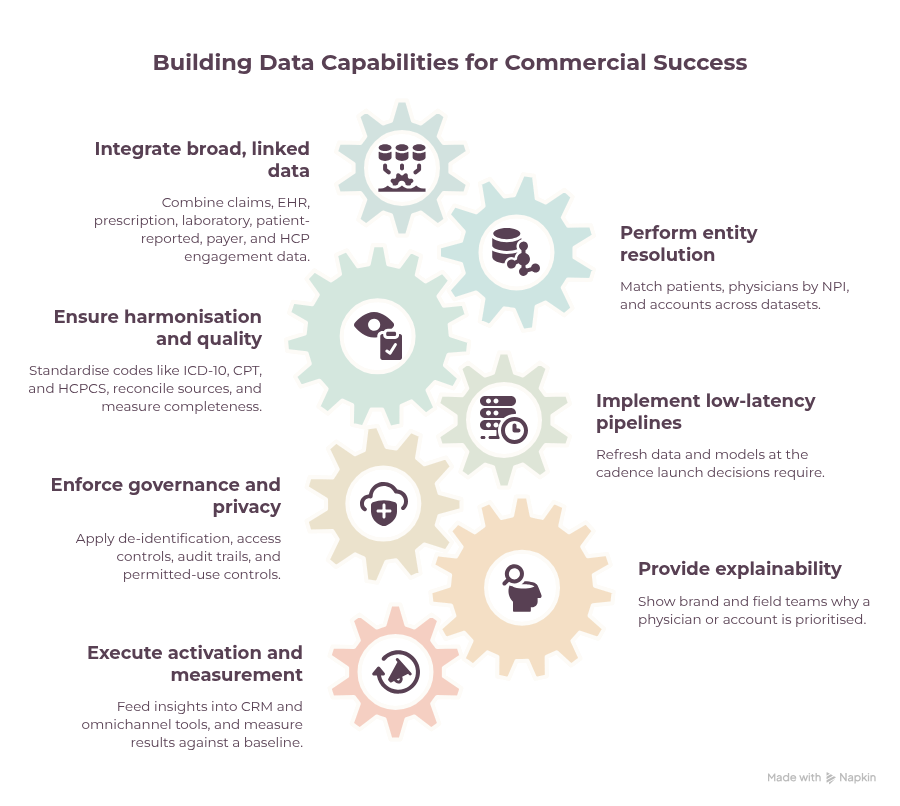
What a launch analytics foundation requires
A model is only as useful as the data and processes around it. The capabilities below separate a working pharmaceutical launch analytics platform from a collection of reports.
This is where healthcare data intelligence matters in a commercial context. The same discipline that makes clinical data trustworthy, harmonisation, lineage, and governance, determines whether launch decisions rest on solid ground.
Compliance, privacy, and regulatory considerations
Linking patient, provider, and engagement data raises the compliance bar. The rules differ depending on whether data is used to generate evidence or promote a product.
Privacy. Patient-level real-world data is protected health information unless it has been de-identified. Under HIPAA, de-identification follows the Safe Harbor or Expert Determination method, and linking claims, EHR, and provider data increases re-identification risk that has to be managed in the design of the platform. Provider-level data, including physician identifiers and industry payments data, carries its own governance and permitted-use considerations.
EU secondary-use rules. Regulation (EU) 2025/327 on the European Health Data Space prohibits using data obtained under a data permit for advertising or marketing activities (Article 54). Most of its secondary use provisions apply from March 2029, but teams planning European launches should already distinguish evidence generation, such as supporting regulatory or reimbursement decisions, from promotional targeting, and expect each to rest on different data and legal bases.
Evidence generation. The 21st Century Cures Act (2016) and the FDA's 2018 Framework for its Real-World Evidence Program set the direction for using real-world data in regulatory decision-making, including pragmatic trials and synthetic control cohorts. Launch analytics that feed payer or regulatory conversations should meet the standards of evidence generation, not those of a campaign report.
AI governance. The FDA's January 2025 draft guidance on AI to support regulatory decision-making [FDA-2024-D-4689] applies where a model generates information intended to support a regulatory decision on safety, effectiveness, or quality, and it excludes AI used for operational efficiency. Commercial analytics that do not support such a decision are unlikely to fall within its scope, but the guidance's principles, a defined context of use, documented evidence of credibility, and ongoing monitoring, are a sound template for any production model. Promotional activity itself remains subject to existing rules on label-consistent claims, and AI that checks messaging for compliance can help without replacing review.
Where drug launch analytics is heading
From lagging reports to continuous loops. Near real-time HCP feedback, ongoing performance monitoring, and predictive models shorten the interval between a signal and a response.
From claims-only data to extended real-world data. The industry is expanding beyond commoditised claims towards patient-centric data that captures outcomes, comorbidities, and real-world complexity. Added to this are unstructured and multimodal sources, such as clinical notes and imaging, that explain why patients are treated as they are.
From siloed outputs to integrated platforms. Questions that once required multiple vendors, static dashboards, and lengthy analytics projects are increasingly answered through AI-powered platforms that allow natural language queries and operationalise real-world evidence in everyday workflows.
From insight to action. Having data is just the start. The advantage goes to organisations that turn it into measurable action across field, medical, and market access teams, and refine it based on what happens next.
That last shift is also where implementation is hardest. Building a good adoption model on a clean dataset is, at this point, a fairly well-understood task. Linking and harmonising real-world data across sources, resolving patients, physicians, and accounts, wiring the outputs into commercial systems, and earning the trust of the teams who must act on them is slower, less standardised work, and it depends as much on clinical and commercial fluency as on engineering.
Reveal HealthTech's life sciences practice is one example of a team working in this space, pairing clinical and product expertise with hands-on AI and cloud engineering on HIPAA-compliant infrastructure, with case work spanning biomarker modelling on time-series clinical data and MLOps deployment for pharmaceutical clients running several production models at once.
Frequently Asked Questions
Drug launch analytics is the use of data and analytical methods to plan, execute, and monitor the introduction of a new medicine. It covers pre-launch market sizing and patient segmentation, launch-stage payer and HCP engagement, and post-launch monitoring of adoption, adherence, and outcomes.
Pharmaceutical launch analytics apply analytics throughout the launch cycle to guide decisions as they happen. Traditional reporting typically summarises prescriptions and sales after the fact, whereas pharmaceutical launch analytics combines real-world data and predictive methods to identify target physicians, track patient journeys, and adjust strategy while the launch is under way.
Real-world data, such as claims, EHRs, prescription trends, and referral patterns, shows where eligible patients are treated, which physicians influence treatment decisions, and where patients drop out before starting therapy. Teams use it to target the right physicians and accounts, understand patient journeys, and adapt engagement as the launch progresses.
Advanced analytics for drug launch refers to methods that go beyond descriptive dashboards, including forecasting and scenario modelling, predictive models of adoption and engagement, natural language processing of unstructured feedback, and next best action recommendations. Its aim is to predict what is likely to happen and guide what to do about it.
Industry research suggests that for most pharmaceutical launches, with 85 percent cited in one widely quoted estimate, the product trajectory is set within the first six months. Early data on physician adoption, payer access, and patient starts therefore matters most, because decisions made in that window are difficult to reverse.
Common challenges include shallow or incomplete claims data, partial linkage between EHR-derived datasets, inconsistent formats and coding, privacy and regulatory requirements, specialist talent shortages, and resistance to adopting new tools. Strong data governance and a clear link between analytics and field action help address them.
It can be, when patient-level data is de-identified through Safe Harbor or Expert Determination or otherwise used on a valid legal basis, access is controlled, and uses are limited to permitted purposes. In the EU, data obtained under a European Health Data Space permit cannot be used for advertising or marketing, so evidence generation and promotional targeting need to be kept distinct.
Blog
The Future of Drug Launch Analytics: Using Real-World Data to Improve Market Adoption
Know the Future of Drug Launch Analytics Using Real-World Data
Discover how real-world data improves drug launch analytics, supports market adoption, identifies patient needs, and drives data-informed pharmaceutical strategies.
From Clinical Notes to MRI Scans: How Multimodal AI Creates Better Research Insights
Multimodal AI in Life Sciences: From Clinical Notes to MRI Scans
Discover how multimodal AI combines clinical notes, MRI scans, and diverse healthcare data to generate deeper research insights and improve life sciences research.