Beyond the chatbot mirage: Why HCLS leaders are reframing AI as a search problem
By Harini Gopalakrishnan, Life Sciences Advisor, Reveal HealthTech Originally presented at the Fierce Pharma Webinar: “You Have the Model, Now What?”
Blog
Beyond the chatbot mirage: Why HCLS leaders are reframing AI as a search problem
By Harini Gopalakrishnan, Life Sciences Advisor, Reveal HealthTech Originally presented at the Fierce Pharma Webinar: “You Have the Model, Now What?”
Most enterprises now have a generative AI strategy, but the challenge has shifted: how do we move from impressive demos to production systems that scale safely and meaningfully? In a regulated industry like Healthcare & Life Sciences (HCLS), the future of AI isn’t about building bigger models, it’s about smarter retrieval.
The core takeaway from our panel with leaders from Novo Nordisk, Alkermes, and Vespa.ai is that we must increase trust with purpose-built retrieval systems. By controlling the data and providing the right context, we reduce hallucinations and ensure AI outputs are grounded in factual, institutional data.
From chatbots to context engines
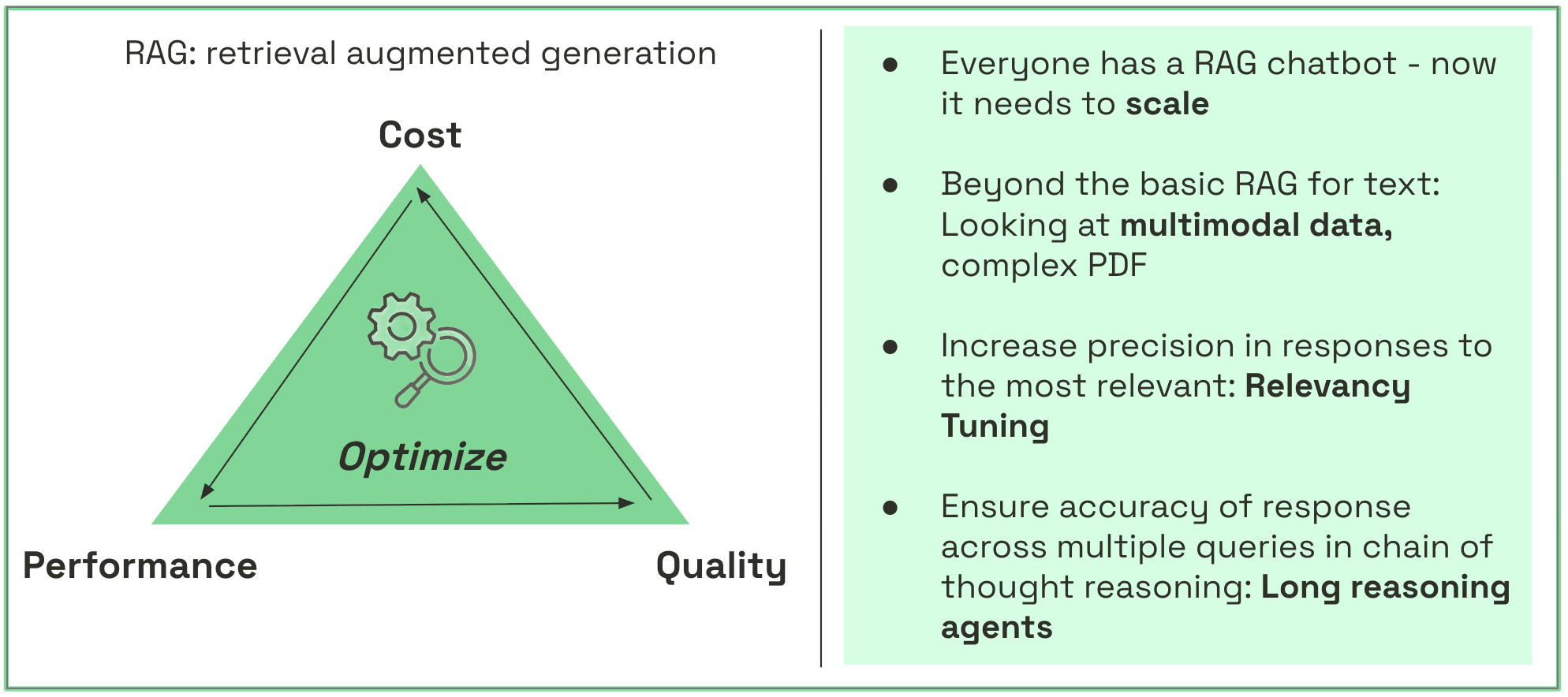
Every RAG (Retrieval-Augmented Generation) solution must balance three competing priorities: cost, performance, and quality.
Challenges with RAG scale up today
To succeed at scale, leaders must move beyond the chatbot mindset and design context engines. Context is the additional information a model needs to answer questions it hasn't seen during training. Whether it's internal institutional data or external research, the accuracy of a response depends on how well a system can search, retrieve, rank, and contextualize that information.
Vertical impact: Turning search into intelligence
R&D: Drug discovery as a search challenge
Drug discovery is effectively an exercise in intelligent retrieval. With molecule and protein spaces spanning 1040 to 1070 combinations, a space larger than the atoms in the known universe, the task is to find a needle in a haystack.
Key takeaway: We’ve shifted from building bigger knowledge graphs to building smarter search spaces using tensor embeddings to represent relationships between molecules, proteins, and diseases.
Commercial: Scaling without losing trust
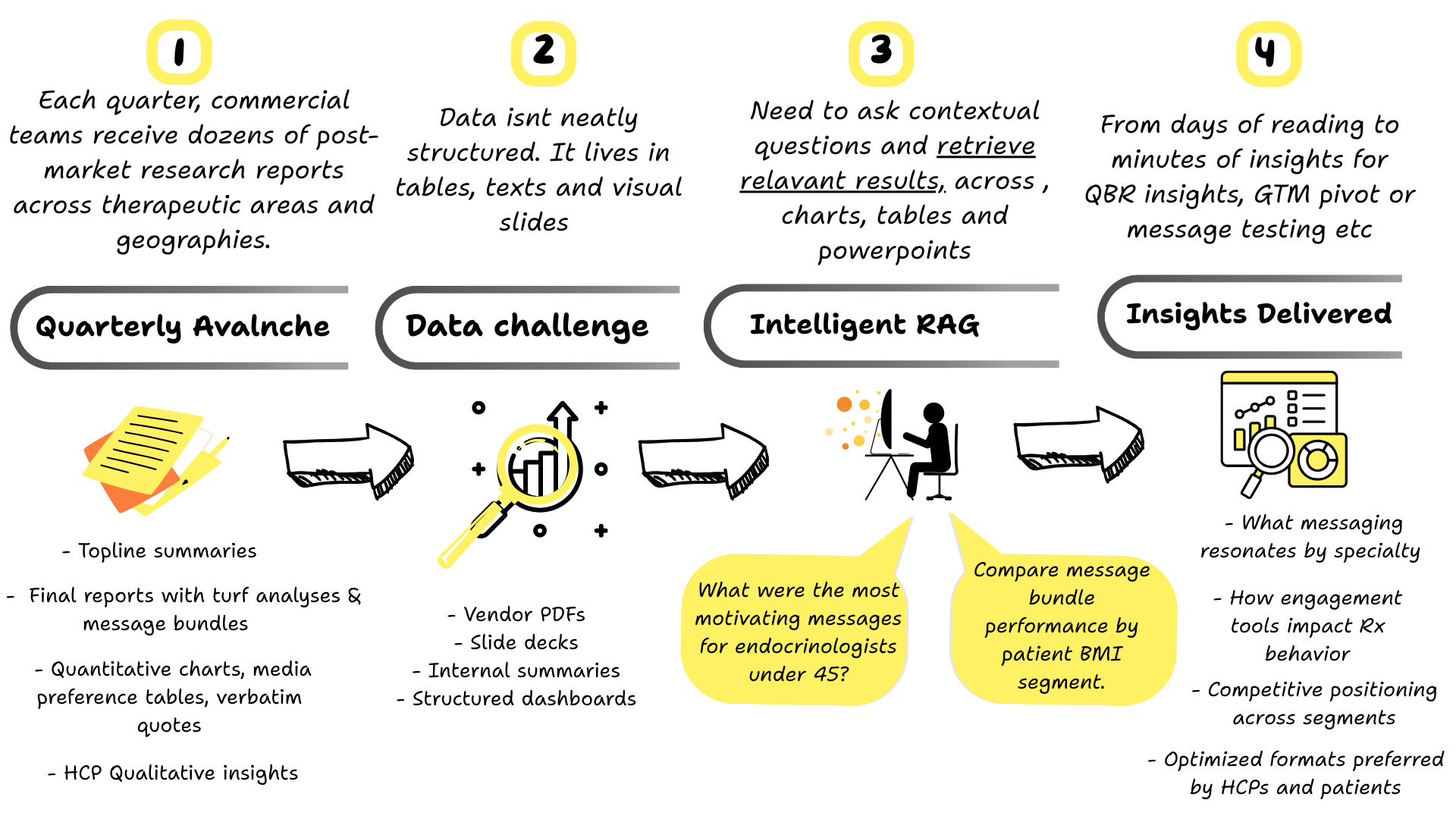
Commercial Insights to be leveraged from post market research documents
Anubhav Srivastava, AI Engineering Head for Commercial at Novo Nordisk, reframed commercial AI is a human-centric search task. Field reps and medical liaisons don’t need another chatbot. They need fast retrieval from an avalanche of multifarious brand documents.
Key takeaway: We must manage the three Ps of AI: Perception, People, and Performance. To these, we add a fourth: Personalization. Retrieval must adapt to the persona, whether it’s a scientist, a rep, or a payer.
Healthcare & payers: Context is everything
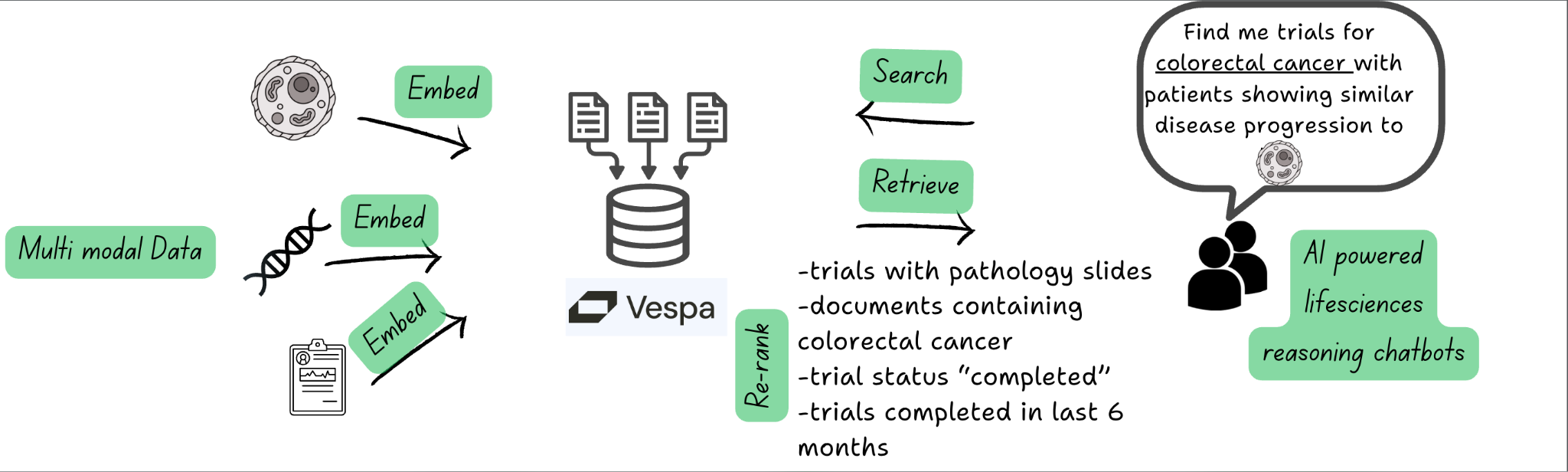
In healthcare, the richest insights live at the intersection of structured claims, unstructured notes, and imaging data. For payers, the challenge is often a lack of retrievable context, which leads to generic care plans.
Building a multi-modal clinical data system for care delivery
Key takeaway: Payers should mimic consumer models like Netflix or Spotify. By using retrieval to compare members with "look-alike" patients, care plans can become dynamic "learning loops" rather than static processes.
Context is the currency
You can’t trust a model to know everything, you must retrieve the right context every time. Whether it is searching molecular space, patient cohorts, or member journeys, the future of HCLS AI is built on smarter retrieval systems.
Design for retrieval first, and intelligence will follow.
About Harini
Harini is a life sciences and technology enthusiast with a global footprint across India, Sweden, Canada, and the US. With a background in Bioinformatics and extensive experience spanning consulting, pharma, CROs, and tech, she is a recognized leader in digital transformation. A winner of the 2020 Gartner Award for Innovative use of Emerging Technology in Pharma and Life Sciences, Harini is driven by an entrepreneurial mindset and a passion for the intersection of technology and biology. She specializes in breaking down complex innovations, from Generative AI and quantum computing to drug discovery and geospatial analytics, into actionable strategic insights for HCLS executives and researchers alike.
Ready to explore how AI can transform your organization? Reach out to Harini at hello@revealhealthtech.com or visit our Contact Us page to schedule a strategy briefing.
Blog
Why Life Sciences Needs Data as a Product
Reusable data products retire one-off analytics and lay a base for AI at scale
One-off analytics leaves Life Sciences teams rebuilding pipelines and reconciling definitions repeatedly. Reusable data products, built on shared engineering and governance, provide a scalable foundation for analytics and AI.
AI in Drug Discovery: Moving Beyond Molecule Identification to Clinical Success
AI in Drug Discovery: From Molecules to Clinical Success
Explore how AI in drug discovery is moving beyond molecule identification to improve target discovery, drug development, clinical trials, and patient outcomes.
As AI scales in health systems, models and data need a shared operating layer.
As healthcare AI scales, healthcare organizations need more than high-performing models. They need an operating layer that integrates data, governance, workflows and human oversight into one coherent, trustworthy environment.

.jpg)