How Pharmaceutical Companies Can Build a Single Source of Truth Across R&D, Clinical, and Commercial Teams
Explore healthcare data interoperability solutions that connect fragmented systems, streamline healthcare data engineering, and improve data exchange.
Blog
How Pharmaceutical Companies Can Build a Single Source of Truth Across R&D, Clinical, and Commercial Teams
Healthcare Data Interoperability Solutions | Reveal HealthTech
Explore healthcare data interoperability solutions that connect fragmented systems, streamline healthcare data engineering, and improve data exchange.
How Pharmaceutical Companies Can Build a Single Source of Truth Across R&D, Clinical, and Commercial Teams
Published: Nov 12th, 2026
Pharmaceutical companies generate extraordinary amounts of data and share very little of it well. Discovery data lives in electronic lab notebooks and omics repositories, clinical data in EDC, CTMS, and safety systems, and commercial data in CRM platforms, claims feeds, and specialty pharmacy datasets. Each function optimises its own systems, and each defines core concepts such as the patient, the product, the site, and the healthcare professional in its own way. The cost shows up in sentiment as much as in systems: in one industry survey, nearly half of senior decision-makers at drug development companies and manufacturers (48 percent) said data silos had undermined cross-functional collaboration.
The practical consequences are familiar. A biomarker hypothesis developed in R&D never reaches the team planning trial eligibility. Site performance lessons from clinical operations are invisible to the launch team. Real-world treatment patterns that commercial teams observe do not inform the design of the next study. Each of these gaps is a decision made on partial evidence. Meanwhile, every cross-functional question triggers a round of extracts, reconciliations, and arguments about whose number is right, and every reconciliation is a point at which an auditor might ask how a figure was derived. Fixing this takes more than moving everything into a central database. It starts with agreeing what a single source of truth really means, and building the interoperability that makes it possible.
Why healthcare data interoperability solutions matter for a single source of truth
A single source of truth is the usual answer, but the phrase is misleading if it implies one enormous database that every function reads from. A more useful definition is a governed, interoperable data layer in which each core concept has one authoritative definition, each number can be traced to its origin, and each team sees what it is permitted to see.
Building that layer is the work of healthcare data interoperability solutions: the standards, mappings, master data, and governance that let systems built for different purposes exchange data that means the same thing on both sides. Without it, different systems hold conflicting or out-of-date versions of the same fact, and teams spend their time deciding which is right.
The sections that follow set out why the problem persists, what interoperability actually involves, which standards pharma can build on, what the architecture looks like, what each function gains, and how to approach governance and delivery without falling into the common traps.
Why a single source of truth is hard in pharma
The difficulty is rarely a lack of technology. It is structural. Each function has its own systems, its own standards, and its own questions.
Function
Typical systems
Typical standards and vocabularies
Typical question
R&D
ELNs, LIMS, omics and preclinical repositories
Ontologies and reference sources such as SNOMED, UniProt, and PubMed
Which target or biomarker is worth pursuing?
Clinical
EDC, CTMS, eTMF, safety databases
CDISC (CDASH, SDTM, ADaM), MedDRA, WHODrug
Is the trial enrolling, safe, and on track?
Commercial
CRM, claims, specialty pharmacy, EHR-derived real-world data
ICD-10, CPT, NDC, provider identifiers such as NPI
Who is adopting the product, and where are patients lost?
Four structural factors keep the picture fragmented.
Different vocabularies for the same reality. A patient is a subject identifier in EDC, a tokenised record in claims data, and a diagnosis cohort in commercial analytics. Without explicit mappings, these are three unrelated things.
Mergers, outsourcing, and IT islands. Pharma companies have historically bought separate solutions for R&D, manufacturing, and finance, and acquisitions add legacy systems of their own. When work such as clinical trials is outsourced, each partner brings its own tools and conventions, and rolling these islands together later becomes expensive.
Copies and local fixes. Where shared data is hard to reach, teams make their own copies, which multiplies versions and compounds the problem. Budget constraints and competing priorities tend to delay the platform investment that would remove the need for them.
Storage mistaken for integration. Data lakes do not automatically curate or master data. Moving every silo into one location without harmonising definitions, identities, and codes produces a larger silo, not a source of truth.
What interoperability actually means
Interoperability is often reduced to connectivity, but connectivity is only the first of four layers.
Layer
What it solves
Typical approaches
Technical
Reliable, secure exchange between systems
APIs, HL7 FHIR REST interfaces, secure messaging
Structural
Shared formats and structures
FHIR resources, CDISC SDTM, ADaM, and ODM, DICOM
Semantic
Shared meaning
SNOMED CT, LOINC, RxNorm, MedDRA, WHODrug, OMOP
Organisational
Shared ownership and rules
Data governance, stewardship, access policies, data contracts
Most failed integrations solve the first two layers and skip the third. Two systems can exchange a file perfectly and still disagree about what a ‘responder’ or an ‘adverse event’ is. The fourth layer is what keeps the other three working over time, because standards, systems, and people all change.
The standards pharma can build on
Pharma does not need to invent a common language. Much of it already exists, though no single standard covers the whole lifecycle.
CDISC for clinical data
For clinical data, the foundation is in place. CDISC standards, including CDASH for data collection, SDTM for tabulation, and ADaM for analysis datasets, are required by the FDA and Japan’s PMDA and recommended by China’s NMPA. Applying them from the start of a study gives consistent structure across studies and partners, and a common language between clinical operations, biostatistics, and regulatory teams. The limitation is scope: CDISC was designed for clinical research data, not for discovery data or commercial datasets, so it anchors one part of the picture rather than all of it.
HL7 FHIR and the bridge to clinical research
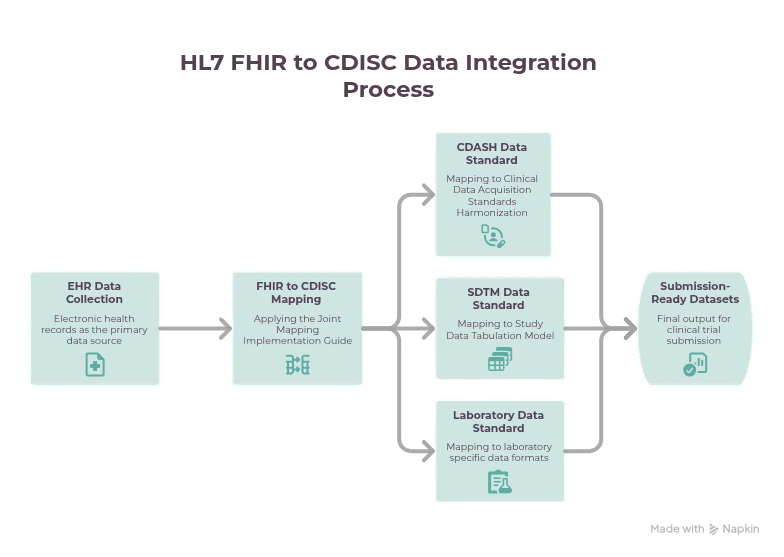
HL7 FHIR has become the common language for exchanging healthcare data electronically, and its relevance to pharma lies in the bridge to research. In 2021, CDISC and HL7 jointly released the FHIR to CDISC Joint Mapping Implementation Guide, which defines mappings between FHIR and CDASH, SDTM, and laboratory data standards to streamline the flow from EHRs to submission-ready datasets. In practical terms, it points towards less re-entry of EHR data into trial systems, and data that arrives closer to submission-ready.
Terminologies and common data models
Shared meaning comes from shared vocabularies. SNOMED CT, LOINC, and RxNorm describe clinical findings, laboratory tests, and medications. MedDRA and WHODrug serve adverse event and drug coding in clinical and safety work, and observational research often uses the OMOP common data model to standardise structure and vocabulary across sources. Commercial data brings its own code sets, including ICD-10, CPT, and NDC, along with provider identifiers such as NPI. A single source of truth needs explicit, maintained mappings between these families, and someone accountable for keeping them current.
What a single source of truth looks like in practice
This is the territory of healthcare data engineering: building pipelines that are not only fast but validated, versioned, and traceable, in an environment where a wrong join can alter a safety or efficacy conclusion. Applying DataOps principles, including automation, continuous integration, and built-in quality checks, is a common way to keep those pipelines reliable as sources change. A working architecture typically has six components.
Component
Role
Interoperability payoff
Source connectors and ingestion
Bring in data from ELNs, LIMS, EDC, CTMS, safety, CRM, claims, and real-world data feeds, in batch and streaming form
Removes manual extracts and untracked copies
Standards-based harmonisation
Map source structures and codes to FHIR, CDISC, OMOP, and agreed terminologies
Makes data comparable across functions and partners
Master data management
Maintain authoritative records for patients (tokenised), sites, investigators, HCPs, products, and studies
Gives every team the same identity for the same entity
Metadata, catalogue, and lineage
Record definitions, owners, and every transformation from source to output
Lets anyone trace a number to its origin
Governance and access control
Enforce purpose, consent, and role-based access at attribute level
Allows wide sharing without indiscriminate sharing
Data products and APIs
Serve curated, documented datasets to R&D, clinical, and commercial users
Replaces ad hoc extracts with reusable, versioned outputs
A single source of truth does not have to mean a single physical store. Some organisations consolidate into a central lakehouse. Others federate, leaving data in place and exposing it through a shared semantic layer. The right choice depends on data volume, sovereignty requirements, latency, and existing investment. What matters is that definitions, identity, and lineage are shared.
What each function gains
The case for a shared data layer is clearest in the flows between functions.
Eligibility criteria, endpoint selection, and patient stratification
Clinical to Commercial
Trial population characteristics, subgroup results, and safety profile, within the bounds of consent and label
Evidence generation, medical education, and market access planning
Commercial to R&D and Clinical
Real-world treatment patterns, unmet need, and adoption barriers
Trial design, feasibility, and lifecycle strategy
All functions to Regulatory and Safety
Lineage-tracked evidence and consistent product and study identifiers
Submissions, pharmacovigilance, and inspection readiness
Research and development
Linking discovery findings with clinical and real-world outcomes lets teams test whether a biomarker hypothesis survives contact with patient data, and reuse historical trial data when evaluating new targets. Without shared identifiers and vocabularies, that reuse depends on one-off mapping projects that rarely outlive the team that built them.
Clinical development
Clinical teams gain most from interoperability at the point of data capture. EHRs have historically used their own proprietary standards, which meant clinical research data needed mapping or re-entry, and the FHIR to CDISC work aims to reduce that duplication. Real-world data can also inform feasibility, site selection, and eligibility before a protocol is locked, and consistent site and investigator identifiers make central monitoring across studies possible.
Commercial and medical affairs
Healthcare interoperability solutions matter as much on the commercial side: commercial leaders surveyed in one industry playbook ranked interdepartmental silos as their top challenge. With shared data in place, launch analytics can draw on trial-derived endpoints and subgroup definitions, medical affairs can answer evidence questions without a bespoke data pull, and patient-journey insights can flow back to development teams.
Regulatory, safety, and medical affairs
Regulatory teams are among the clearest beneficiaries. Many still rely on legacy technology that silos data across R&D phases, and interoperability solutions in healthcare help them with document compilation, gap identification, submission preparation, and real-time oversight. They also save time otherwise spent searching for the right documentation or translating pre-written reports into the format an agency requires, and they keep submissions consistent across the R&D lifecycle. The benefits extend into safety and medical affairs, where secure data sharing can make clinical trial results available to pharmacovigilance teams as soon as they exist, rather than after a manual hand-off.
Governance, privacy, and regulatory considerations
A single source of truth does not mean everyone sees everything. The more functions share a platform, the more precisely it has to control who may use which data, and for what purpose.
Purpose limitation. Clinical trial participants consent to specific uses of their data, and privacy laws such as HIPAA and the GDPR restrict reuse beyond them. Commercial use of trial-derived or patient-level data needs a clear legal basis, de-identification where required, and access controls that enforce purpose, not merely role. In the EU, Regulation (EU) 2025/327 prohibits using data obtained under a health data permit for advertising or marketing activities (Article 54). Most of its secondary use provisions apply from March 2029, with clinical trial and human genetic data following from March 2031.
Data integrity. Data that supports GxP-regulated decisions has to meet ALCOA+ expectations: attributable, legible, contemporaneous, original, and accurate, plus complete, consistent, enduring, and available. 21 CFR Part 11 audit trail and record integrity controls and GAMP 5 Second Edition validation practices apply to the platform that integrates the data, and changes to mappings and transformations need change control like any other validated element.
AI on top of the platform. Models that draw on the integrated layer inherit its quality and its limits. The FDA’s January 2025 draft guidance on AI to support regulatory decision-making [FDA-2024-D-4689] centres on a defined context of use and documented evidence of credibility. Where a model supports a regulatory decision, lineage from output back to source is part of that evidence.
Standards governance. Standards evolve. CDISC implementation guides, FHIR versions, and terminologies are revised on their own cycles, so the platform needs a documented process for adopting changes without breaking downstream users.
Where single-source-of-truth programmes struggle
The honest position is that the case is strong in principle and the published evidence is thin. Much of the material on pharma data integration comes from vendors selling integration, and quantified benefits are rarely accompanied by baselines. Several failure patterns recur.
Big-bang centralisation. Attempts to consolidate everything before delivering anything exhaust budgets and goodwill, and value arrives late or not at all.
Mapping without ownership. Semantic mappings decay unless someone is accountable for them. A mapping built for one study becomes silently wrong as vocabularies and source systems change.
Technology without stewardship. A platform without data owners, a shared glossary, and clear decision rights becomes another silo with better branding.
Ignoring unstructured and non-standard data. Clinical notes, images, documents, and instrument outputs often hold the context that makes structured data meaningful, and standards cover them least.
Underestimating the people challenge. Technology is rarely the hardest part. Adopting shared processes means persuading people used to working their own way, and where the value is unclear or the return uncertain, reticence follows. Data literacy training and regular cross-functional reviews of data quality, timeliness, and usefulness help build the culture a shared source depends on.
No measure of success. Without a baseline, no one can tell whether the programme reduced reconciliation effort or merely moved it.
Measuring progress
A few measures keep a programme honest:
Time to answer a defined cross-functional question, from request to trusted result
Share of key entities (patients, sites, products, HCPs) with a mastered identifier
Lineage coverage for datasets used in submissions and major decisions
Reconciliation effort between functions, measured in hours or disputes
Reuse: the number of teams consuming the same curated dataset
A practical roadmap
Start with decisions, not systems. Choose two or three cross-functional questions that matter, such as which biomarker-defined subgroup is most prevalent in real-world practice, and work backwards to the data required.
Agree shared definitions and owners. Define the core entities (patient, study, site, product, HCP) and the vocabularies that describe them, and name a steward for each.
Adopt standards at the boundaries. Use FHIR, CDISC, and agreed terminologies where data crosses a system or organisational boundary, rather than rewriting every internal system.
Build a thin harmonisation layer with lineage from day one. Begin with the datasets the first questions need, using validated pipelines and traceability, and extend from there.
Govern by design. Encode consent, purpose, and access rules in the platform so that sharing is controlled by policy rather than by whoever holds the extract.
Deliver data products and measure. Serve documented, versioned datasets to each function, and track the measures above against a baseline.
Why interoperability decides whether the single source of truth holds
A single source of truth is not a product that can be bought and switched on. It is the outcome of agreed meaning, maintained mappings, controlled access, and traceable pipelines, sustained over years as standards, systems, and organisations change. Building the pipelines is a well-understood engineering task. Agreeing definitions across R&D, clinical, and commercial teams, validating the integrated data against clinical and regulatory expectations, and earning the trust of each function is slower, less standardised work, and it depends as much on domain fluency as on engineering.
Reveal HealthTech’s life sciences practice is one example of a team working in this space, pairing clinical and product expertise with hands-on AI and cloud engineering on HIPAA-compliant infrastructure, with case work spanning biomarker modelling on time-series clinical data and MLOps deployment for pharmaceutical clients running several production models at once.
Frequently Asked Questions
Healthcare data interoperability solutions are the standards, tools, and practices that let different systems exchange data and interpret it consistently. They typically cover technical exchange (APIs and messaging), shared structure (such as HL7 FHIR and CDISC), shared meaning (terminologies such as SNOMED CT and MedDRA), and the governance that keeps definitions and access under control.
A single source of truth in pharma is a governed data layer in which each core concept, such as a patient, study, site, or product, has one authoritative definition and every figure can be traced to its origin. It does not require a single physical database, and it does not mean every team can see all data.
Pharma data is created in separate systems by R&D, clinical, safety, and commercial teams using different vocabularies. Without interoperability, insights cannot flow between functions, cross-functional questions require manual reconciliation, and it is harder to show regulators how a result was derived.
Clinical data typically relies on CDISC standards (CDASH, SDTM, ADaM), which the FDA requires for study data submissions. HL7 FHIR supports exchange with healthcare systems, and a joint CDISC and HL7 guide maps FHIR to CDASH, SDTM, and laboratory data standards. Terminologies such as SNOMED CT, LOINC, RxNorm, MedDRA, and WHODrug, and common data models such as OMOP, supply shared meaning, while commercial data adds code sets such as ICD-10, CPT, and NDC.
Healthcare data engineering is the design and operation of the pipelines, models, and platforms that move, transform, and govern health and life sciences data. It differs from general data engineering in its emphasis on validation, traceability, privacy, and compliance with regulations such as HIPAA and GxP.
A data lake stores data, whereas interoperability solutions make it comparable and trustworthy. A lake does not by itself curate or master data, so without mapping to standards, master data management, and lineage, it can hold the same silos in a single location.
Only within the limits of participant consent, privacy law, and company policy. Access should be controlled by purpose as well as role, patient-level data should be de-identified where required, and in the EU, data obtained under a European Health Data Space permit cannot be used for advertising or marketing.
AI models are only as reliable as their inputs. A harmonised, linked, and traceable data layer gives models consistent features, lets teams document where each input came from, and supports the credibility evidence regulators expect when a model informs a regulatory decision.
{
"@context": "https://schema.org",
"@type": "FAQPage",
"mainEntity": [
{
"@type": "Question",
"name": "What are healthcare data interoperability solutions?",
"acceptedAnswer": {
"@type": "Answer",
"text": "Healthcare data interoperability solutions are the standards, tools, and practices that let different systems exchange data and interpret it consistently. They typically cover technical exchange through APIs and messaging, shared structure such as HL7 FHIR and CDISC, shared meaning through terminologies such as SNOMED CT and MedDRA, and governance that keeps definitions and access under control."
}
},
{
"@type": "Question",
"name": "What is a single source of truth in pharma?",
"acceptedAnswer": {
"@type": "Answer",
"text": "A single source of truth in pharma is a governed data layer in which each core concept, such as a patient, study, site, or product, has one authoritative definition and every figure can be traced to its origin. It does not require a single physical database, and it does not mean every team can see all data."
}
},
{
"@type": "Question",
"name": "Why is data interoperability important for pharmaceutical companies?",
"acceptedAnswer": {
"@type": "Answer",
"text": "Pharma data is created in separate systems by R&D, clinical, safety, and commercial teams using different vocabularies. Without interoperability, insights cannot flow between functions, cross-functional questions require manual reconciliation, and it is harder to show regulators how a result was derived."
}
},
{
"@type": "Question",
"name": "Which standards support interoperability across R&D, clinical, and commercial data?",
"acceptedAnswer": {
"@type": "Answer",
"text": "Clinical data typically relies on CDISC standards such as CDASH, SDTM, and ADaM, which the FDA requires for study data submissions. HL7 FHIR supports exchange with healthcare systems, and a joint CDISC and HL7 guide maps FHIR to CDASH, SDTM, and laboratory data standards. Terminologies such as SNOMED CT, LOINC, RxNorm, MedDRA, and WHODrug, and common data models such as OMOP, supply shared meaning, while commercial data adds code sets such as ICD-10, CPT, and NDC."
}
},
{
"@type": "Question",
"name": "What is healthcare data engineering?",
"acceptedAnswer": {
"@type": "Answer",
"text": "Healthcare data engineering is the design and operation of the pipelines, models, and platforms that move, transform, and govern health and life sciences data. It differs from general data engineering in its emphasis on validation, traceability, privacy, and compliance with regulations such as HIPAA and GxP."
}
},
{
"@type": "Question",
"name": "How do healthcare interoperability solutions differ from a data lake?",
"acceptedAnswer": {
"@type": "Answer",
"text": "A data lake stores data, whereas interoperability solutions make it comparable and trustworthy. A lake does not by itself curate or master data, so without mapping to standards, master data management, and lineage, it can hold the same silos in a single location."
}
},
{
"@type": "Question",
"name": "Can commercial teams use clinical trial data?",
"acceptedAnswer": {
"@type": "Answer",
"text": "Only within the limits of participant consent, privacy law, and company policy. Access should be controlled by purpose as well as role, patient-level data should be de-identified where required, and in the EU, data obtained under a European Health Data Space permit cannot be used for advertising or marketing."
}
},
{
"@type": "Question",
"name": "How do interoperability solutions in healthcare support AI in pharma?",
"acceptedAnswer": {
"@type": "Answer",
"text": "AI models are only as reliable as their inputs. A harmonised, linked, and traceable data layer gives models consistent features, lets teams document where each input came from, and supports the credibility evidence regulators expect when a model informs a regulatory decision."
}
}
]
}
Blog
The Future of Drug Launch Analytics: Using Real-World Data to Improve Market Adoption
Know the Future of Drug Launch Analytics Using Real-World Data
Discover how real-world data improves drug launch analytics, supports market adoption, identifies patient needs, and drives data-informed pharmaceutical strategies.
From Clinical Notes to MRI Scans: How Multimodal AI Creates Better Research Insights
Multimodal AI in Life Sciences: From Clinical Notes to MRI Scans
Discover how multimodal AI combines clinical notes, MRI scans, and diverse healthcare data to generate deeper research insights and improve life sciences research.